
Direct selling leadership teams are asking a different question than they were five years ago.
Not, “Should we modernize ecommerce?” But, “What foundation should we build on?”
Shopify is increasingly becoming that foundation. That shift reflects a structural change in how ecommerce is evaluated.
Consumer Expectations Changed First
Customers now expect:
- Fast checkout
- Mobile-first design
- Flexible payments
- Frictionless subscriptions
- Seamless global transactions
Shopify has become the default infrastructure for that experience across retail, DTC, and global commerce brands.
Direct selling operates within that same expectation.
When the replicated, front end ecommerce experience feels dated or unstable, distributor credibility erodes along with conversion.
Direct Selling Introduces Real Complexity
Ecommerce in direct selling is not just storefront and checkout.
It includes:
- Attribution across replicated sites
- Enrollment logic tied to sponsorship
- Subscription and autoship alignment
- Commission volume mapping
- Qualification cycles
- Refund logic that impacts payout
That complexity does not disappear when you move to Shopify. It must be structured correctly.
What changes is how you design the architecture around it.
Why Shopify Is Emerging as the Default
More direct selling leadership teams are recognizing something simple.
Shopify does ecommerce better than most direct selling platforms.
It evolves quickly.
It invests deeply.
It supports a global ecosystem.
It sets the standard for checkout performance.
Replicating that inside commission software has proven difficult.
The conversation has shifted from “Can Shopify work for direct selling?” to “How do we implement Shopify responsibly for direct selling?”
Shopify for Direct Selling Requires Structure
Running Shopify for direct selling is not a simple app install.
It requires:
- Clear system boundaries
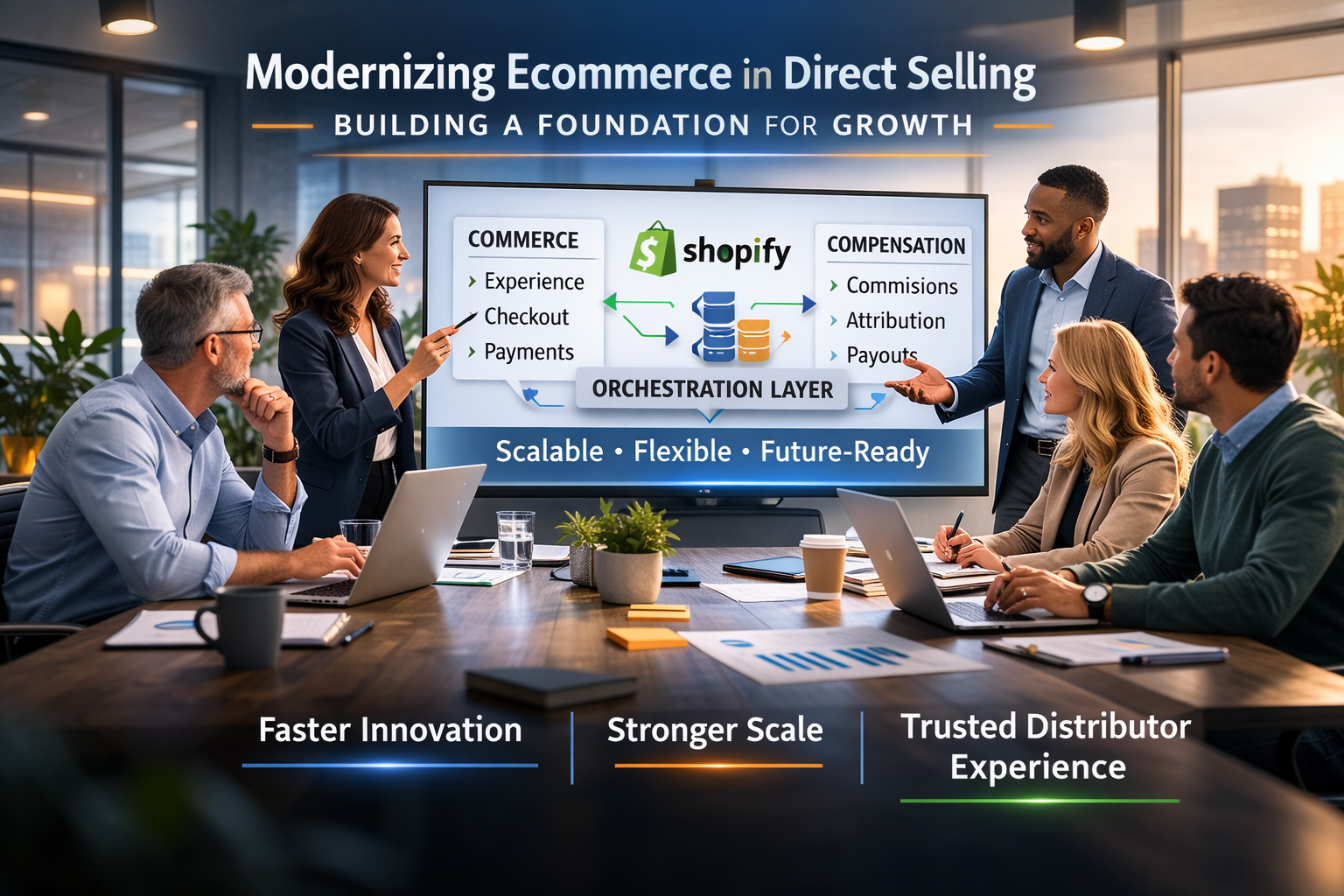
- A defined orchestration layer
- Identity coordination
- Transaction normalization
- Attribution integrity
- Subscription alignment
When those elements are structured properly, Shopify becomes a durable ecommerce foundation rather than a customization experiment.
Ecommerce and compensation work best when each system owns what it was built to do.
The Competitive Shift
Historically, many direct selling companies relied on:
- Embedded ecommerce inside commission systems
- Full-stack direct selling platforms
- Custom integrations maintained internally
Those approaches can function. Over time, iteration slows and maintenance overhead grows.
As the broader ecommerce ecosystem accelerates, the gap becomes more visible.
Leadership teams are now asking what scales cleanly over time, not just what launches fastest.
Where This Is Heading
Over the next several years, direct selling ecommerce will likely consolidate around a clearer model:
- Shopify as the commerce engine
- Commission systems as the authority for business rules
- A structured orchestration layer connecting the two
That model preserves velocity and protects compensation integrity.
It allows innovation without forcing replatforming cycles every growth phase.
Final Thought
If you are evaluating Shopify for direct selling and would like to compare notes on how Shopify can be structured correctly for direct selling, we are glad to continue the conversation.
Visit www.shopiq.com
Email sales@shopiq.com
.jpeg)
.jpeg)

.png)