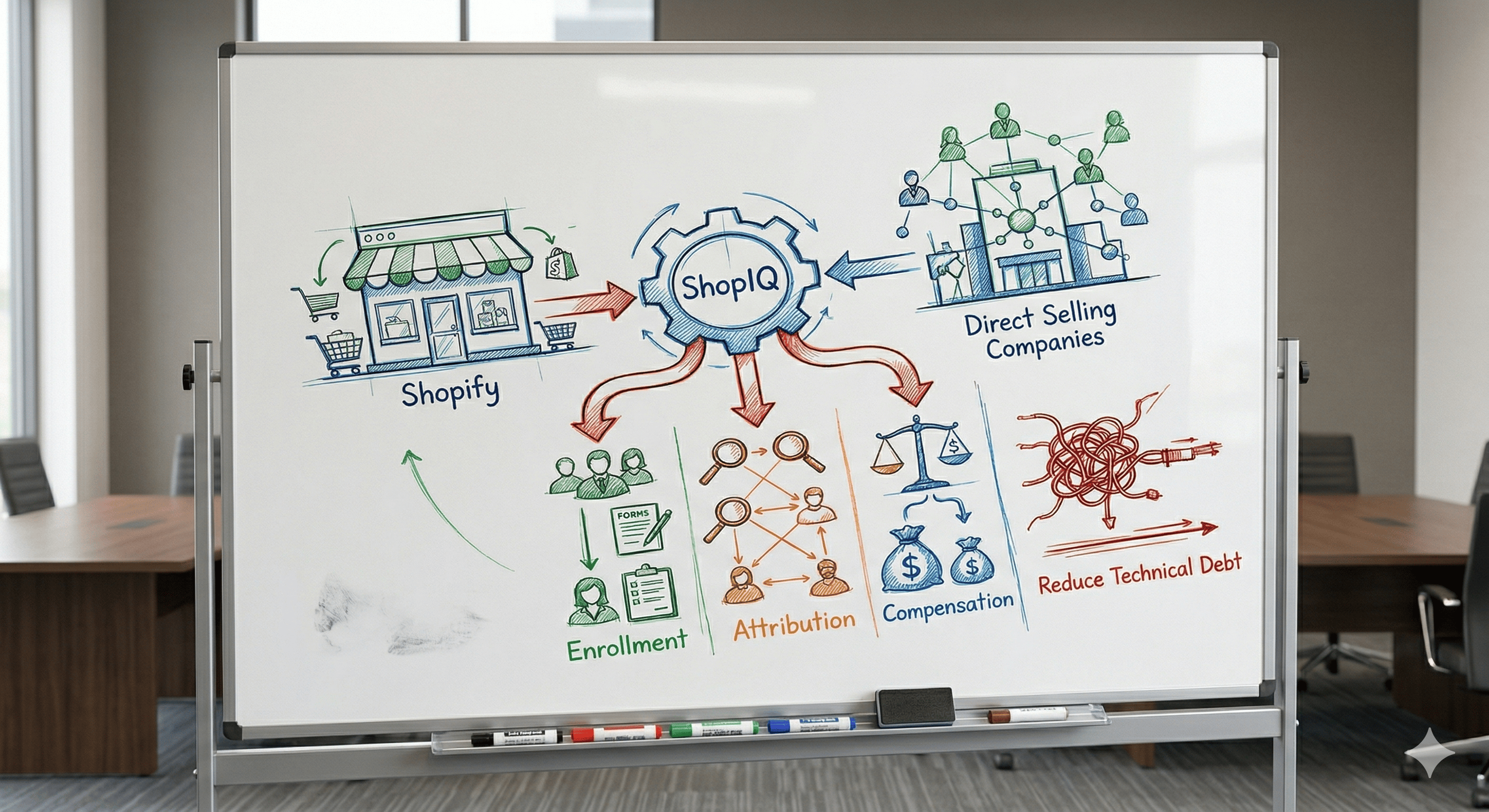

A unified experience is a common goal in direct selling right now. At The Future of Commerce event, Blake Mallen, CSO at Herbalife, pointed to a shift toward a modern ecosystem with best-in-class options and capabilities.
That is the right outcome.
In direct selling, the hard part of modern ecommerce is keeping Shopify, enrollment, attribution, subscriptions, and compensation aligned as real buying behavior gets messy. Many teams end up paying for that misalignment in delays, custom work, and a support burden that never fully goes away.
Blake notes that today's ecommerce innovation starts on Shopify—period. He is right. But in direct selling, a unified experience depends on unified systems.
The field feels the fragmentation pain first
When something is misaligned, the field notices before internal teams do. A consultant shares a link and a customer lands somewhere unexpected. An enrollment flow feels disconnected from purchase. A subscription renewal breaks attribution.
Each moment is small. Together they shape trust.
They also create platform debt. Every workaround becomes something your team has to maintain, explain, and reconcile. Blake highlights that Shopify sites require less technical effort to build, maintain, modify, and extend. That only stays true if you avoid building brittle custom logic that fights the platform.
A unified experience is the sum of these moments behaving predictably.
Identity is the hidden layer
Direct selling introduces more identity states than standard ecommerce. A person may be a customer, a prospect, an enrolling distributor, or a distributor connected to a sponsor.
Those states change during real buying journeys.
A unified experience requires identity coordination across systems. If identity is fragmented, the experience cannot stay consistent. Blake argues for a shift toward unified commerce where one data model leads to more sales. This requires a foundation that understands who the person is and who they are connected to at every step.
Enrollment and checkout must coordinate
Direct selling often treats enrollment and checkout as two separate motions. Customers treat them as one.
Blake highlights that Shopify has the world's fastest converting checkout. For direct selling brands, the goal is to get people through that checkout without losing the data required for commissions. A unified experience depends on clean coordination between sponsor assignment, attribution, and the checkout events that produce clean payout inputs.
When those dependencies are unclear, teams rely on workarounds. Workarounds do not scale.
Data visibility only helps when it is trustworthy
Blake calls out the importance of Shopify's relentless innovation, noting their $1.7 billion R&D spend. That investment provides incredible visibility into customer behavior.
Visibility is only useful when data is consistent across systems. When orders, discounts, refunds, and subscription events are not standardized, reporting becomes harder and decision-making slows. Trustworthy data supports cleaner reconciliation, better support outcomes, and more confidence in compensation results.
Structure that supports a unified experience
Ecommerce and compensation work best when each system owns what it was built to do. Blake describes Shopify as the world's most flexible platform. It should own the storefront and checkout experience.
Direct selling business rules must remain authoritative inside commission and back-office systems.
ShopIQ sits in the gap where others fail. We act as the orchestration layer between Shopify and direct selling systems. This structure supports a unified experience without forcing one system to do the job of another.
Recommendations for next steps
To move toward a unified model, I recommend these steps:
- Audit your identity transitions: Map exactly how a guest becomes a customer or a distributor. Look for friction points where the system "forgets" the sponsor relationship.
- Standardize your transaction data: Ensure that refunds and partial returns in Shopify trigger the exact corresponding adjustment in your commission engine automatically.
- Protect the checkout: Avoid adding heavy custom apps to the checkout page that might slow down the sub-second performance Blake mentioned.
If you’re evaluating Shopify for direct selling, let's talk. Visit www.shopiq.com Or email sales@shopiq.com
.jpeg)
.jpeg)

.png)